
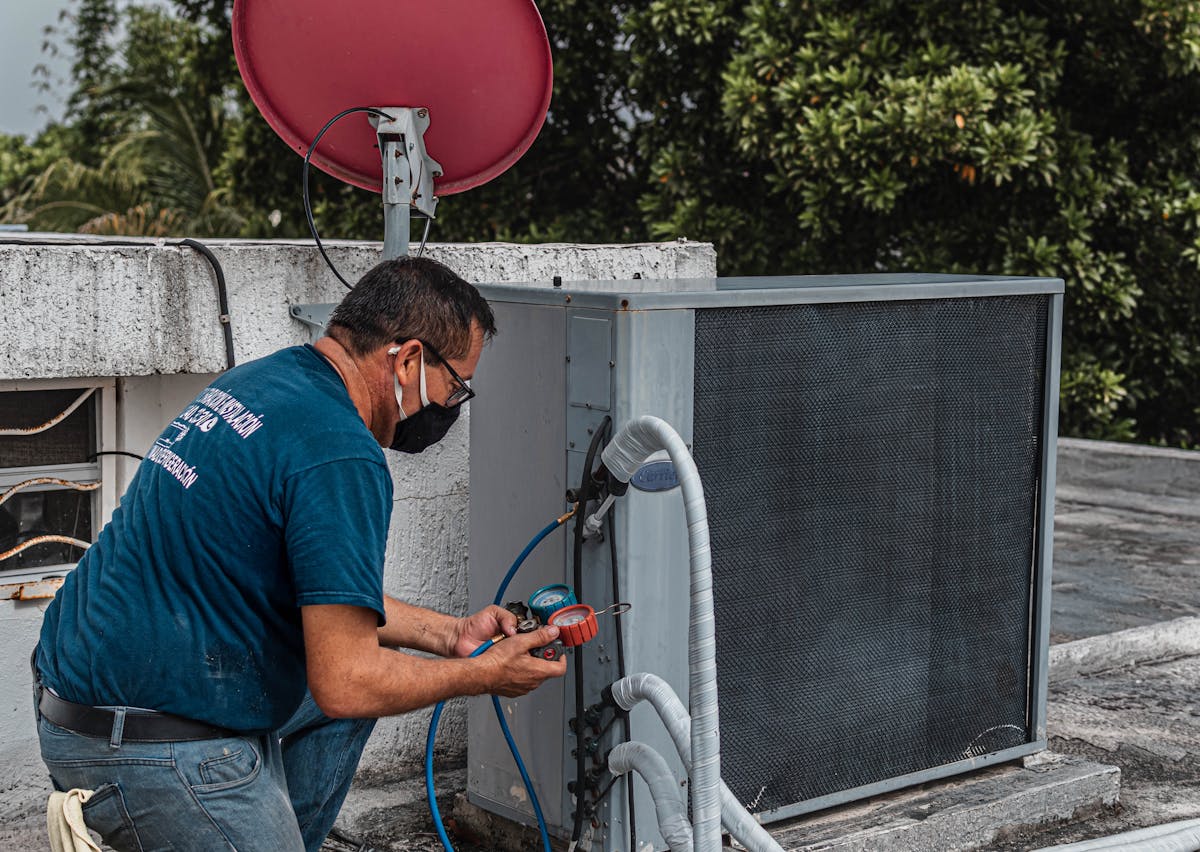
Photo by José Andrés Pacheco Cortes on Pexels
Updated November 3, 2026 · By Michael Gonzales · Prices from Angi and HomeGuide
Disclosure: 1-800Deals is a contractor directory. We may earn a commission from some affiliate links on this site, at no extra cost to you. Listings never change the facts or prices on this page.
Short answer: Replacing a furnace and central air conditioner together costs about $5,000 to $12,500 installed in 2026, with a $7,500 average, per Angi. Central air alone runs $3,900 to $8,000. A full air source heat pump system runs $10,000 to $25,000 or more, per HomeGuide. Ductwork and efficiency tier move quotes most.
Compare local HVAC companies, or let us match you with pros.
Replacing a matched furnace and central air conditioner costs about $5,000 to $12,500 installed in 2026, with a $7,500 average, per Angi. Central air alone runs about $3,900 to $8,000, and a full air source heat pump system runs about $10,000 to $25,000 or more installed, per HomeGuide.
Those are the published ranges we checked in October 2026. The spread inside each range is not noise. System size, efficiency tier, ductwork condition and local labor rates move a real quote thousands of dollars in either direction.
This piece covers installed equipment cost only. Incentives are a separate subject with their own rules, and they are covered in the rebate guides linked at the end rather than repeated here.
How much does HVAC replacement cost by system type?
| System type | Installed cost range, 2026 | Source |
|---|---|---|
| Central air conditioner only | $3,900 to $8,000 | Angi |
| Furnace only, all fuels | $2,800 to $6,900, $4,800 average | Angi |
| Gas furnace only | $3,800 to $12,000 | HomeGuide |
| Furnace plus central AC, existing ducts | $5,000 to $12,500, $7,500 average | Angi |
| Furnace plus central AC with new ductwork | $7,000 to $16,000 | HomeGuide |
| Air source heat pump, full system | $10,000 to $25,000+ | HomeGuide |
| Heat pump unit swap on an existing system | $3,800 to $8,200 | HomeGuide |
| Ductless mini split | $3,000 to $10,000 | HomeGuide |
| Geothermal heat pump | $15,000 to $35,000 | HomeGuide |
Swipe to see more
Sources: Angi, new furnace and AC cost (updated July 9, 2026), HomeGuide, new HVAC system cost and HomeGuide, heat pump vs. furnace cost, checked October 2026. HomeGuide puts the national average HVAC replacement at $8,000, with jobs reported from $2,500 to $18,500.
Treat any single national average with caution and weight local quotes more heavily, because labor is a large share of the total and labor rates are local.
A like for like swap, where the new equipment matches the old in size and type and the ductwork is sound, sits at the low end of each band.
A conversion, such as moving from a furnace and AC pair to a heat pump, or from a ducted system to ductless, sits at the high end because it adds line set, electrical and sometimes duct changes on top of the equipment price.
What does furnace replacement cost on its own?
A furnace alone runs about $2,800 to $6,900 installed on Angi's figures, and HomeGuide puts a gas furnace replacement at $3,800 to $12,000. Within that band, the efficiency tier is the main lever.
A standard 80 percent AFUE furnace is the lower priced option and vents through a chimney or metal flue. A high efficiency condensing furnace at 95 percent AFUE or above costs more for the unit, needs PVC venting and a condensate drain, and uses less gas for the same heat output.
For furnace only pricing in more depth, see our furnace replacement cost guide.
Furnace only replacement makes sense when the air conditioner is much newer than the furnace, which is common because furnaces often last 15 to 20 years and air conditioners 10 to 15.
When both are near the end of their service lives, replacing them together is usually cheaper than two separate jobs, because the indoor coil, labor visit and permitting overlap. Angi's combined band of $5,000 to $12,500 is less than the two separate high ends added together for that reason.
What does a heat pump cost installed?
A full air source heat pump system runs about $10,000 to $25,000 or more installed, per HomeGuide, while swapping the heat pump unit on an existing system runs about $3,800 to $8,200. A heat pump does both jobs, heating and cooling, so the fair comparison is not heat pump against furnace alone.
It is heat pump against furnace plus air conditioner together, Angi's band of $5,000 to $12,500. On that comparison a full heat pump system usually still costs more to install, and the gap is widest for cold climate models and conversions.
Cold climate models cost more than standard models. They hold capacity at low outdoor temperatures and carry higher HSPF2 ratings, which matters in northern states where a standard model would rely on backup heat for long stretches. Backup heat itself is a cost line to identify in a quote.
Electric resistance backup adds equipment cost and raises running costs on the coldest days, while a dual fuel setup pairs the heat pump with a gas furnace and switches between them by temperature.
Ductless mini splits price differently again, at about $3,000 to $10,000 per HomeGuide, with a single zone serving one room or addition at the low end and multi zone systems at the high end. They avoid duct losses entirely, which is why they are often quoted for homes without existing ductwork, where adding ducts would otherwise be a major extra cost.
What extras move an HVAC quote up or down?
These are the line items that explain most of the distance between a low quote and a high quote for the same house:
- Ductwork repair or replacement. New ductwork adds about $2,400 to $6,600 per HomeGuide, and fixing leaky or undersized ducts changes how well any new system works.
- Electrical work. A new panel, a panel upgrade or new circuits for a heat pump can add several hundred to several thousand dollars, depending on the existing service.
- Efficiency tier. Two stage and variable speed equipment costs more than single stage. HomeGuide says high efficiency furnaces cost 30% to 100% more than standard models.
- System size. Equipment is sized in tons for cooling and BTUs for heating. A 5 ton system costs materially more than a 2 ton system, and oversizing is a cost with no benefit, since an oversized system cycles on and off and controls humidity poorly.
- Permits and code work. HomeGuide puts permits for a replacement at $100 to $250. Most jurisdictions require a permit for a system replacement, and older installations sometimes need venting, gas line or condensate changes to meet current code.
- Disposal and access. Haul away of the old equipment, attic or crawl space access, and crane or roof access for packaged units all appear as separate lines in some quotes.
Ask for each of these as a separate line. A single lump sum quote cannot be compared against another contractor lump sum, because you cannot tell whether the difference is equipment, labor or extras one contractor included and the other left out.
How long does a new HVAC system last?
Service life planning is part of the cost picture, because a system that lasts longer spreads its installed price over more years.
Commonly cited service lives in industry guidance are about 15 to 20 years for a gas furnace, 10 to 15 years for a central air conditioner, and about 15 years for an air source heat pump, which runs in both summer and winter and so accumulates more operating hours than either a furnace or an air conditioner alone in most climates.
Those are planning figures, not guarantees. Maintenance, installation quality, duct condition and climate all shift the outcome. A correctly sized system on sound ductwork, with filters changed and annual service kept up, is the version most likely to reach the top of its range.
How can you compare HVAC quotes fairly?
- Compare the same scope. Same system type, same size, same efficiency tier, and the same extras listed separately, as set out above.
- Ask for the model numbers and the AHRI certificate for the matched system, so the efficiency rating is a certified figure rather than a brochure figure.
- Ask what is not included. Electrical upgrades, duct changes, permits and disposal are the usual gaps.
- Check licensing for your state. Our contractor licensing hub and the HVAC directory, which listed 469 HVAC companies when checked in October 2026, are starting points for finding local firms to quote the job.
- Ask about the labor warranty separately from the manufacturer parts warranty. They are different promises from different parties, and the labor term varies widely between contractors.
Where do rebates fit into HVAC replacement cost?
Rebates and credits do not change the installed price on a quote. They change what you pay net, after program rules are applied, and they have eligibility, equipment and contractor registration conditions that are separate from the purchase itself.
To keep this guide to installed cost, the incentive detail lives in the dedicated guides: heat pump rebates for heat pump incentives, HOMES and HEAR rebates by state for state program status, and the home energy rebates by ZIP code finder for what applies at a specific address.
Check those before you sign, because some programs require approval or a registered contractor before installation, and installing first can remove the option. The related heat pump water heater rebates guide covers the water heating side if that appliance is due at the same time.
Frequently asked questions
How much does it cost to replace a furnace and AC together in 2026? Angi puts a matched furnace and central air conditioner at about $5,000 to $12,500 installed, with a $7,500 average, as of July 2026. High efficiency equipment, larger systems, ductwork changes and electrical upgrades push a quote above that band.
Is a heat pump cheaper than a furnace and AC? Usually not on installed price. A full air source heat pump system runs about $10,000 to $25,000 or more per HomeGuide, against about $5,000 to $12,500 for a furnace plus AC per Angi, though one heat pump replaces both.
Running cost depends on your electric and gas rates and your climate, so the cheaper system to buy is not automatically the cheaper system to run.
What is the most expensive part of an HVAC replacement? Equipment is usually the largest single share, followed by labor. The extras that surprise homeowners most are ductwork changes and electrical upgrades, which is why they should appear as separate lines in every quote you compare.
Should you replace a 15 year old furnace before it fails? On the service life figures used in this guide, a 15 year old furnace is at or past the point where replacement planning makes sense, especially if the air conditioner is a similar age.
Replacing on your schedule lets you compare quotes and equipment. Replacing after a mid winter failure usually means taking the first available option.
Does a new HVAC system need a permit? In most jurisdictions, yes. A system replacement normally requires a mechanical permit and an inspection, and the contractor usually handles the filing. Confirm that the permit cost is in the quote and that an inspection is scheduled, since an unpermitted install can cause problems at resale.
Sources
- Angi: How much does a new furnace and AC cost?, updated July 9, 2026
- HomeGuide: How much does a new HVAC system cost?, checked October 2026
- HomeGuide: Heat pump vs. furnace cost, checked October 2026